Since 2016, Rich Collins has been plunging into the pitch-black waters off the coast of Palm Beach, Florida, at night, camera in hand, in pursuit of blackwater photography. These nighttime dives have given him a unique window into the lives of sea creatures, including many that usually stay hidden in deeper waters, but come up to the surface after dark to feed.
One thing Collins and his fellow divers have observed over the years is that some juvenile fish interact with larval tube anemones in interesting ways, with the fish either sticking close to the anemones or even carrying them around. These “symbiotic associations” are described in a recent paper published in the Journal of Fish Biology, for which Collins was a co-author.
“The bradmids [pomfret fish] tend to surf on them [anemones] or ride them, or they grab them with their pectoral fins,” Collins, a diver affiliated with the Florida Museum of Natural History, told Mongabay. “The filefishes tend to grab things with their mouths and carry them around.”
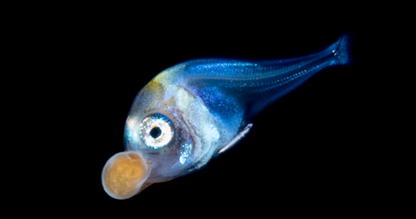
Pomfret fish with a larval anemone. Image courtesy of Linda Iannielli.
Blackwater images of these associations, taken in the epipelagic waters of both Florida and French Polynesia, found their way to Gabriel Afonso, the study’s lead author and a doctoral student at the Virginia Institute of Marine Science.
“They’re beautiful photos,” Afonso told Mongabay. “People like them, but researchers look to them with different eyes — we look to them as a source of information.”
Drawing from the photos, Afonso and his co-authors described the “mutualistic interaction” between open-water fish — including orange filefish (Aluterus schoepfii), spotted driftfish (Ariomma regulus), big-eye jacks (Caranx latus) and Atlantic pomfret (genus Brama) — and larval anemones and button polyps (Zoanthus sociatus). While these interactions have never been scientifically documented before, other research has chronicled mutualistic relationships between clownfish (genus Amphiprion) and mature anemones attached to the seafloor. There are also studies that have looked at the associations between fish and jellyfish.
In mutualism, the interaction is beneficial for both creatures. The authors hypothesize that the fish were likely clinging to the anemones for self-defense, since anemones are known to be toxic. While larval forms of anemones might not be toxic enough to kill predators, they would still “produce venom” that would be “unpalatable” to predators, according to Afonso.
The authors also hypothesize that the anemone could benefit since the fish could help them disperse to other parts of the ocean. However, Afonso said there’s still more that needs to be understood about these mutualistic relationships.
Alan Verde, a professor of biology at Maine Maritime Academy who studies symbiotic relationships with cnidarians (invertebrates that include anemones, jellyfish and corals), said he “had no idea that the larval stages of these fish were also interacting with the larval stages of these cnidarians.”
“Those larval stages are just so weird and vastly different from the adults on some of these animals,” Verde, who wasn’t involved in the study, told Mongabay. “It’s very cool that they associate so closely with each other.”
Verde agreed that the fish could benefit from the anemones for defense reasons. He also offered his own hypothesis for the possible benefit that anemones might reap: “Given the close proximity, these cnidarians may get nutrients from the fish. So the fish is excreting nitrogen through the gills; it’s pooping out feces. And so if the fish and this cnidarian are just swimming around in a small area, there could potentially be nutrients that the cnidarian can acquire because they’re soft bodied.
“Plus, if the fish happens to bite something and it fragments a little bit, then there’s those scraps that are available to be taken up by these larval cnidarians,” Verde added. “So I think definitely this could be a mutualistic symbiosis, in that both are benefiting.”
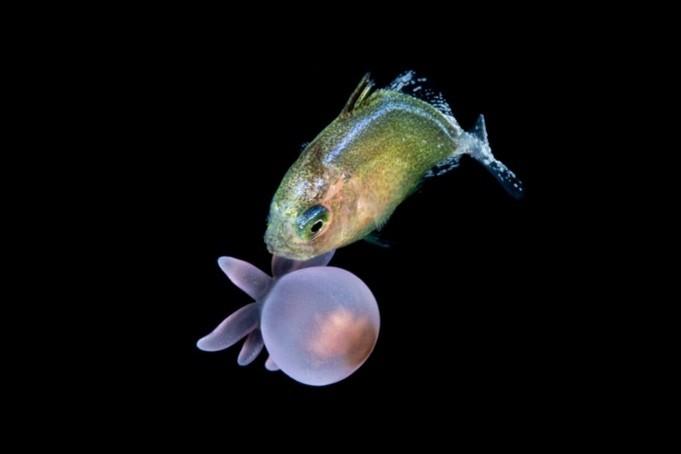
Symbiotic associations between a fish and an anemone. Image courtesy of Linda Ianniello.
Verde agreed that more research is needed to fully understand these relationships. The paper, he added, has prompted him to consider the scientific opportunities blackwater diving could offer.
“I do most of my diving in Washington state over the summer, working on octopus and sea cucumbers,” Verde said. “I bring a couple students out to help with the work, but we’ve never done any blackwater diving there. So we might have to actually see what’s out there.”
Afonso, G. V., Johnson, G. D., Collins, R., & Pastana, M. N. (2025). Associations between fishes (Actinopterygii: Teleostei) and anthozoans (Anthozoa: Hexacorallia) in epipelagic waters based on in situ records. Journal of Fish Biology. doi:10.1111/jfb.70214
Reprint from Mongabay.com