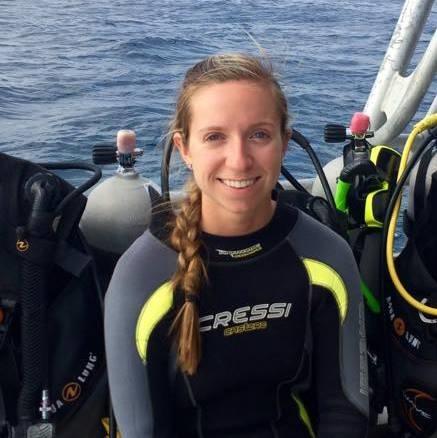
 Madelyn Roycroft
Biological Science Master’s Candidate-Cal Poly, San Luis Obispo
Master's Scholarship Recipient, 2016
“Crunch... crunch... crunch.” I will never forget the first
time I heard the unforgettable sound of a parrotfish grazing on coral reefs.
Nearly two years after hearing that sound for the first time, I, along with my
research team and hundreds of pounds of scientific dive equipment, headed from
California to the Caribbean. The island of St. Croix, part of the U.S. Virgin
Islands, was our destination; our mission: to get to know these charismatic
parrotfishes on a more personal level. Our focus was to study the feeding
behavior of the resident parrotfish species, who are important herbivores in
coral reef systems.
Herbivory on coral reefs is a recent focus of research, as
herbivores often consume algae in a way that is beneficial to the growth and
recovery of live coral. Parrotfishes are an abundant herbivore on coral reefs
and provide a plethora of positive impacts, particularly by consuming a
significant amount of algae on the reefs. Interestingly, each parrotfish
species, which come in an assortment of colors from stunning greens and blues
(Image 1) to rainbow sherbet (Image 2), plays a unique role in their
community. For example, the Queen parrotfish, Scarus vetula eats
mostly small turf algae on complex reef structure, while the Yellowtail
parrotfish, Sparisoma rubripinne prefers a bushy, brown
macroalgae on a range of substrate types. Our current knowledge of parrotfish
behavior comes from studies conducted in locations that have an abundance of
each key parrotfish species. However, in some locations such as St. Croix,
these fishes are an important source of nutrition, income and cultural value to
the local fishing community and are thus subject to high fishing pressure and
species loss.
My project as a California Polytechnic State University
Master’s student in the Ruttenberg lab, supported by the Kevin Gurr
Scholarship, was to determine whether fishing pressure and subsequent species
loss has had an effect on parrotfish feeding behavior, and ultimately their
positive impact on the coral reefs. We gathered feeding behavior data by using
SCUBA and followed individual parrotfishes of each species for 20 minutes at
three sites around the island (Image 3). During this time we recorded data such
as what food each fish ate and how many bites it took, all while towing a
surface float with a GPS unit to track how far the fish traveled (Image 4). A
highlight of this study was to be able to dive the beautiful Buck Island Reef
National Monument (Image 5). I was prepared for this challenging data
collection technique thanks to my rigorous AAUS scientific diving training
through the University of North Carolina Chapel Hill and experience as a dive
technician prior to my graduate studies.
Although research is still ongoing, my data so far has shown
that, broadly, parrotfish species in St. Croix play similar roles to the same
species in other Caribbean locations. At a higher-resolution, we do see
fine-scale differences in feeding behavior, but we are still working to
determine if fishing pressure, species loss, or other environmental variables
caused such differences. We also found that three key parrotfish species
typically found throughout the Caribbean were absent from the reefs on St. Croix.
Similar to the dysfunction and loss of productivity if a restaurant were to
lose entire positions such as cooks, servers, and receptionists, this absence
indicates the loss of important roles from these St. Croix reefs and potential
decline in reef condition if these roles remain unfilled
The Kevin Gurr scholarship not only provided me the means to conduct a
dive-intensive field season in the Caribbean to answer important ecological
questions, but also gave me the opportunity to develop important relationships
with members of the St. Croix fishing community, National Park Service and the
University of the Virgin Islands. Over the course of three seasons in St.
Croix, I developed relationships of trust and respect with local fishermen who
granted me rare access in personal interviews to the family traditions and
food-dependence associated with parrotfish and other species. Through
conversations with these individuals, I learned the importance of incorporating
both cultural and ecological value into metrics for fisheries management in
collaboration with local residents. I hope to maintain the relationships that I
made through this project and continue to promote discussions between the
fishing community, scientists, and policymakers on how to manage the parrotfish
fishery in St. Croix in a way that will result in measurable success for all
stakeholders.
So, the next time you have the opportunity to snorkel or
dive on a coral reef, take the time to listen for that unmistakable “crunch,”
and observe the parrotfishes that are crucial to maintain the health of our
beautiful coral reefs. You never know what interesting behavior you might
witness!
Thank you AAUS for awarding me the Kevin Gurr scholarship
and the opportunities that came from it.