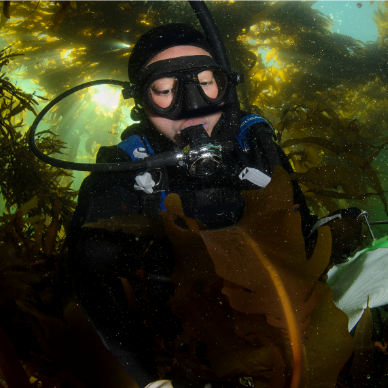
 Gabrielle Rungsiya Keeler-May
AAUS Scholar 2025 Update
I was awarded the AAUS
scholarship in 2019 while diving nearly every week for my PhD research in
Aotearoa New Zealand. That support came at a critical time and helped me build
the foundation for an unforgettable few years of fieldwork, removing and studying Undaria pinnatifida, an invasive kelp species that has taken
hold across much of the country’s coastline.
My research
projects ended up spanning three regions, more than 130 subtidal sites, and
over 40 dive trips. I worked alongside iwi (tribal partners) throughout my
projects; this grounded the science in multigenerational place-based knowledge and helped shape my understanding of what restoration was, is and could be.
Over the years, my team and I hauled out over 20 tonnes of Undaria by hand and monitored how the ecosystem responded. The
results showed that, even after Undaria becomes
established, large-scale removal can still reduce its spread and dominance,
something many managers had started to doubt.
During graduate school, I also
worked as a scientific diving contractor, logging hundreds of dive hours beyond
my own research. These included ecological surveys for proposed marine
protected areas, seafloor imaging and sediment sampling to support bathymetric mapping, invasive species control using machinery and
field prototypes, and seaweed harvesting trials aimed at methane reduction.
Supporting these interdisciplinary projects gave me a deep appreciation for
collaborative science and strengthened my skills in field planning, dive
safety, and adaptive logistics.
Since
finishing my PhD, I’ve stayed close to applied science and restoration. As a
postdoc at Chapman University, I worked on invasive species control in California’s Bay-Delta, building a spatial model to help the Suisun Regional Conservation
District prioritize where and how to act. One of the most meaningful parts of
my postdoc was mentoring undergraduate students through California Sea Grant.
Supporting them as they grew into community-based researchers and explored connections between environmental
literacy and climate advocacy across language barriers was a real highlight. I
also spent a year as an Instructional Professor at Chapman, teaching
environmental science and GIS courses. It was a great opportunity to bring
field experiences into the classroom and help students connect scientific
methods with real-world challenges, especially around equity and
decision-making.
Now I work with NOAA Fisheries as a Marine Habitat Resource Specialist and serve as the Tribal Liaison for the Office of Habitat Conservation. I still rely on the
lessons I learned underwater: how to slow down and pay attention to the small
things, how to plan (and re-plan) in the face of changing conditions, and how to build trust with the people you're working with. Diving isn’t something I do every day anymore, but it continues to shape how I collaborate with partners and steward
federal habitat restoration funds throughout our communities.
I'm grateful
to AAUS for helping me get in the water all the way back in 2012 as an
undergraduate student, then later supporting me in 2019 as a doctoral student
and ultimately for building a community that values field science and hands-on learning. My dive years were formative, and I still carry them with me in how I think, lead, and show up
in my work today.